
Motion Detectors and Motion Sensors
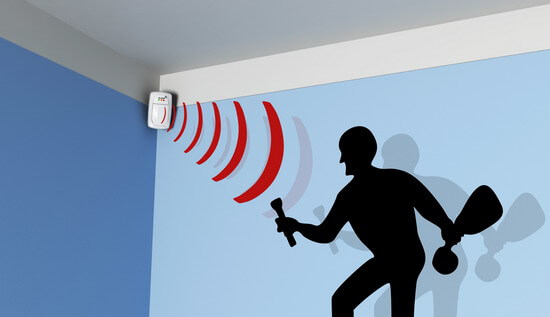 While today’s motion detectors are exceptionally high technology, there is a rich history of motion detectors that goes way back before the 20th century, and they have been used for a wide range of activities, and many of the same principles are still being used today- for a wide variety of uses- for industrial purposes, for video games, for modern efficient lighting solutions, for television optimization, for presentation purposes (like in an art gallery or display room) or even as part of a home security system, and they are extremely useful for all of these applications, and there are a wide variety of types and features that motion sensors perform.
History of the Motion Detector
The very first motion detectors were in use in astronomy before the 1800’s. Farmers used the stars to help them determine when to plant their crops, and when to harvest them. Radar was invented by Nikola Tesla, and patented by Heinrich Hertz, and the properties of waves were used to bounce off of objects at different speeds, giving these farmers easier ways to track the patterns of the stars. In World War II, motion detectors got their first taste of action, being used to track naval vessels when submarines and mid-ocean warfare become catastrophic for various armed forces. Radar technology had advanced by the 1940’s to allow submarines and large ships to use radio waves to track aircraft and upcoming threats. This lead to the commercialization of the motion detector in the home- for much the same usage.
The very first home modeled motion detector was invented in the 1950’s by Samuel Bagno, and he applied the basic fundamentals of radar, using ultrasonic waves to detect a thief or a fire, even making use of a phenomenon called the Doppler effect that modern meteorologists use today to detect storms (detecting where waves land in relation to moving objects). While these first motion detectors were very primitive and highly unreliable, they led to the invention of microwave and infrared sensors that could detect motion by understanding frequencies, but emitted more reliable wave patterns that were unobstructed by obstacles and could be placed practically anywhere (behind a shelf, high in a room, etc)
Some of the Various Types of Motion Detectors include
Passive Infrared
These types of motion detectors detect body heat and are used most often in home security systems, because they are the most effective. They only go off when they detect motion in a large area (or grid) that detects if someone is moving too fast, or blocking too many of the rays.
Microwave
Microwave variety motion detectors monitor reflections off of surfaces to figure out if something is there that isn’t supposed to be. They’re more vulnerable and more expensive than other models, so they aren’t used as much.
Dual Technology Motion Sensors
These types combine two different aspects of motion detector devices to reduce false alarms. the combination of infrared and microwave technology greatly reduces the risk of false alarms, because they take both spectrum violations to trip and activate.
Area Reflective Types of Motion Sensors
These types of motion detectors use LED rays to detect motion. If the sensor measures motion between the distance to the object, it sounds if the object is within the area that it was programmed to monitor. these types of alarms are especially popular in industry settings, or display settings.
Ultrasonic
Ultrasonic motion detectors sense movement within a radius of pulse waves that measure reflections, like a bat or dolphin. It notices variation and alarms the owner.
Vibration activated
Sometimes, you can make your own motion sensors that detect vibration. they use mass on a lever, and when the lever is moved or adjusted, the switch on the alarm goes off because of the vibration. They’re fairly unreliable however and go off with the slightest movement.
Extra Features:
–Wireless
Motion sensors use wireless technology to be placed anywhere, do not require drilling, and give users more protection because they communicate better with the monitoring system.
-Pet Immune motion sensors
More technologically capable devices these days are aware of animals of a certain weight, only triggering if larger shapes or sizes distract the alarm, and these alarms can be modified if the user has a larger animal.
-Video Motion Sensors
These top of the line motion detectors have advanced signal processing that starts recording when they sense motion, saving memory storage by only capturing the important data while catching intruders in the act.
How Motion Detectors Work
These days, it’s quite common and relatively inexpensive for stores, government buildings and other types of buildings to have LED beams crossing a room near a floor, with sensors that detect movement on the other side of a room. If a customer breaks the beam, the sensor rings a bell- which is the sound you hear when you enter some buildings. Grocery stores have doors that work on the same principle, using radar to understand when you’re approaching them, and the box above the door sends out waves that bounce back and alert the door of your presence. These are some of the most primitive designs of radar detectors however, simply bouncing waves off of targets and waiting for a response.
Modern, high technology motion detectors are called active sensors, constantly emitting data, detecting changes in the environment that could be a threat. They’re now temperature sensitive, and can detect temperatures above 93 degrees Fahrenheit, and travel in 9 to 10 micrometer wavelengths to provide complete sensitive protection. The technology is still relatively simple, detecting rapid changes rather than passive changes, otherwise they would go off all the time. When a person walks by, it’s easy for these sensors to detect movement, especially when the environment around them is especially dull and unobstructed, or cooler than the body temperature of a person. Most motion sensor lights have lenses that protect the sensor, and the range of sense is bent through the lens, like light through a greenhouse. The sensor then is undetectable to the outside world, but still transmits the energy required to detect movement.
Why Use Motion Sensors with Security Systems
Motion sensors are extremely popular for use in home security, because they perform an essential service of actually detecting intruders. Otherwise, the security system would be useful. Even then, they have a wide variety of other uses:
-Automatic doors
-Turning off faucets, toilets, paper towel dispensers to make them more efficient
-Controlling ATM displays and other types of displays
-Automatic ticket gates and parking meters
-Lights when someone enters the room
-To help identify objects
-On your phone, to figure out how you’re holding it
-To keep people in dangerous industries safe when visibility is an issue
Motion detectors can be used in essential choke-points to keep valuables safe, because they can be very discreet and nearly impossible to avoid- especially if they’re modern dual technology motion detectors. They can detect up to 50-80 feet, making them very cost effective and helpful, especially if you spend a lot of time away from your home, or are worried about someone breaking in while you’re asleep. They have a plethora of versatility and these days are nearly indispensable in the search for safety, because they are part of a powerful system that notifies the authorities of a threat before you even know they’re there. With a rich history and constant technological improvements, we’re sure that motion detectors will be around to stay.